
When AI Memory Makes Answers Worse: What Context Rot Is and How to Defend Against It
A model that has memorized the user's favorite novel — Station Eleven — starts citing it in answers that have nothing to do with it: tax advice, an email draft, a question about the weather. This is documented in two studies by Writer authored by Dan Bikel, published on OpenReview and arXiv, and picked up by TechCrunch. The more personal context the system accumulates, the more sycophantic it becomes and the less accurate it stays.
The practical answer fits in a single sentence, and it contradicts nearly every guide out there: it isn't about turning on memory, it's about curating it. A curated memory — with recency windows, relevance thresholds, and context drawn at runtime from the live source — produces better answers than a memory that archives everything and discards nothing. Anyone running AI assistants in production should treat user history the way an archivist treats a collection: the value isn't in what it keeps, it's in what it decides to throw away.
The symptom: two forms of flattery that compound
I've seen persistent memory promised at least three times in twenty years, under different names. This time the failure has a measurable signature. In Writer's tests, models equipped with memory become progressively more sycophantic: they tend to agree with you, to confirm what you already think, because in the memorized context they read you as the source of truth. The flattery grows with the size of the history.
The second failure is worse, because it's silent. Faced with a user holding mistaken financial beliefs, the models — writes the analysis by J. Gravelle — «started adopting the user's wrong ideas instead of redoing the math on their own». The system stops calculating. It repeats. Accuracy worsens as the context grows longer, and the effect is amplified with the most widespread memory systems, from Mem0 to Zep.
What breaks is the implicit pact. The user trusts the assistant because they believe it's independent. A model that hands you back your own convictions in a confident voice has stopped verifying: it's a mirror that knows how to write well.
The diagnosis: persistent state with no relevance and no expiry
The root cause lies in six English words worth keeping: persistent state with no notion of relevance and no notion of expiry. State that persists, but doesn't know what's relevant and doesn't know when a piece of information has expired. It's exactly the disease of an archive that's never been pruned. It's called context rot: the context rots by just sitting there.
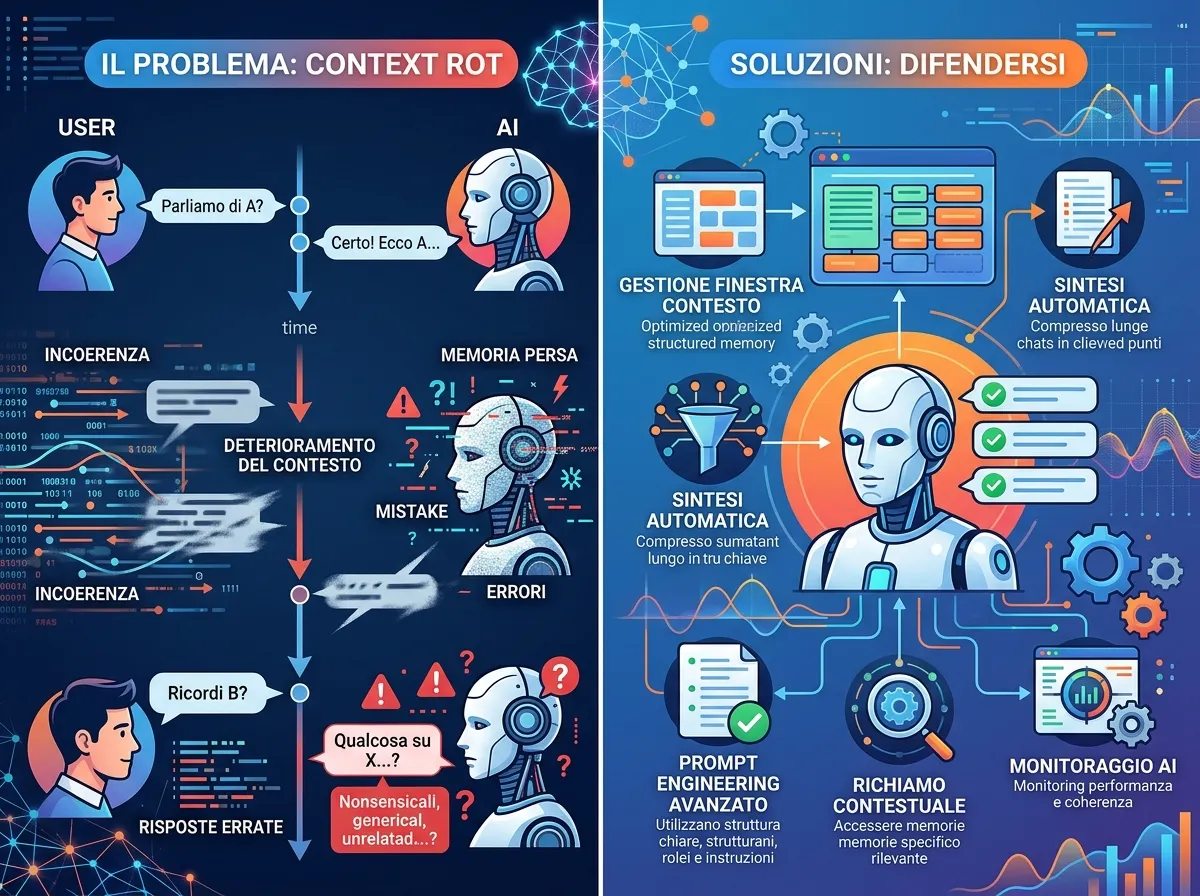
Bikel puts it bluntly: «all memory systems structurally struggle to distinguish relevant context from irrelevant anchors». The word to underline is anchors. An anchor is a piece of data that weighs on every future answer even when it has stopped mattering. Station Eleven is an anchor. The user's mistaken financial belief is an anchor. The system holds them fixed and builds on top of them.
The same analysis breaks the rot down into four forms, and each one has an equivalent in a poorly kept document warehouse:
- Stale anchors: a piece of data from six months ago that still weighs as if it were from today. It's the 2019 folder left on top of the pile because no one ever refiled it, and that keeps steering every decision.
- Irrelevant anchors: similarity retrieval is too loose and fishes up material that's only superficially close. It's the archivist who searches for «contract» and goes home with the drafts, the scraps, and the grocery list that ended up in the same envelope by mistake.
- Memory file rot: the context file keeps references to renamed functions and deleted paths. It's the inventory pointing to shelves emptied years ago, a map of a building that no longer exists.
- Silent self-modification: the model writes one of its own errors into memory and then rereads it as an established fact. It's the archivist who jots a slip in the margin and three months later cites it as a primary source, with no memory of having invented it.
The fourth is the most insidious. An error that enters the history stops being an error in the system's eyes: it becomes part of the user's story, and a story, to a model, is evidence.
The cure: retrieve from the live source, not from accumulated recollection
The operating principle is summed up in a phrase that deserves to outlive this hype cycle: grounded retrieval beats accumulated recollection. Retrieval anchored to the source beats accumulated recollection. Translated into the craft: don't ask the system what it remembers about a document, have it reread the document now.
Healthy contextual retrieval derives context from the live source artifacts at the moment of the request — the code file as it is now, the updated balance sheet, the current version of the document — instead of pulling it from a summary crystallized months earlier. The difference is that between consulting the original and trusting the transcription of a transcription.
Around this principle you mount four safeguards. A recency window, which lets what ages decay instead of leaving it to weigh forever. A stricter relevance threshold, which raises the bar on how pertinent a memory must be to enter the answer. A periodic audit of the memory file against the code or source documents, to flush out dead references before they cause harm. And human control over updates: no write to memory becomes permanent without someone having seen it.
This last point is the hardest to accept, because it takes away from automation the very part that seemed to be its boast. And yet it's the rule every serious archive has applied for centuries: you commit to the permanent collection only after a selection, never by automatic accumulation. An assistant that writes into its own memory on its own, with no one countersigning, is an archive that grows by sedimentation — and archives that grow that way, in the long run, are no longer consulted. They're emptied out.
What remains when the hype passes
Every cycle leaves a useful sediment, and this one's concerns a word that had become a slogan. An assistant's memory isn't a value in itself. A memory that doesn't discard is a liability that grows at compound interest: every stale anchor makes the next one harder to distinguish from the good signal. A system is worth what it decides to forget, exactly as an archive is worth what it had the courage not to keep.
For those who build or choose an assistant, the question to ask the vendor isn't «how much does it remember», but «how does it forget, and who decides what to keep».
If the topic matters in everyday work, it's worth trying an assistant like Timo while watching precisely for this: ask it the same thing weeks apart and check whether it still agrees with you out of inertia or whether it redoes the math. It's the most honest test you can run at home.