
The problem nobody tells you about
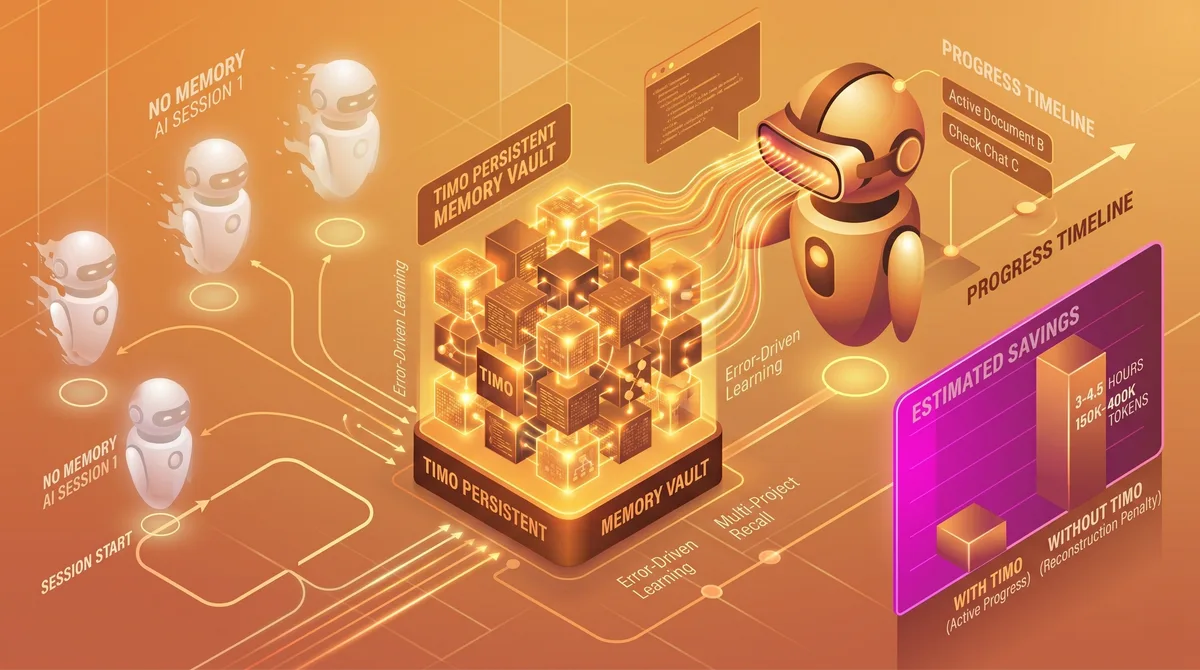
Every time you open a conversation with an AI, it starts from scratch. It doesn't remember yesterday's session, the decisions you made together, how your project was set up, the rules you'd given yourself. It's like having a brilliant colleague who wakes up every morning with no memory of the day before.
Today I picked up some work on one of my projects. The AI I work with — the one that runs the code on the machine — remembered nothing from the previous time. And yet within minutes it knew everything: where the code lives, how it gets published online, which decisions I'd already made and why. Not because it remembered. Because it was all written in Timo, and it read it before starting.
What was already there
At startup the AI read two starting notes and, following them, about ten others: the map of the servers, where the code sits and how it's updated, the project conventions, the agreed working method. Eleven notes already written, six searches in the archive. None of this was reconstructed: it was already there, ready to read.
Today's job
The task was a flaw on two pages of the site: in the English version, part of the text stayed in Italian and a link always pointed back to the wrong home. Concrete stuff, the kind every project has by the dozen. The AI found the right files, replicated the pattern already used elsewhere, fixed four files, and checked that everything compiled without errors.
The mistakes (because they really happened)
It didn't all go smoothly, and this is the honest part of the story. The AI made some real mistakes during the day.
It started modifying the code before reading the working rules I'd set for myself — it only read them afterward. At one point it wrote a wrong rule into the archive about how the project gets published, basing it on an old note instead of verifying: and that wrong rule, applied right after, made the next attempts fail. It tried several times to access a system password through the wrong door, bumping into the security blocks.
The actual fix was ready early. What ate up the time was the dead loop to publish it — and that dead loop came from a piece of information recorded badly.
Here Timo steps in — twice
The interesting thing is how these mistakes got corrected. Not by asking me to re-explain everything. The AI went back into the archive: it reread the correct working method, found — by searching the history with just two operations — how the project had been published the previous times, and put its own understanding back in order.
And then it did the thing that matters most: it rewrote the rules so the mistake won't repeat. It corrected the wrong publishing rule, fixed a pointer that led to a non-existent note, added a "checks before starting" reminder. Eight notes updated, so the next session — which will once again start with no memory — finds the right path already cleared. Today's mistake becomes tomorrow's prevention.
The bill: what it would have cost without
This is the point. If those data hadn't been in Timo today, the AI would have had to reconstruct everything from scratch: map the servers one by one, figure out how the project gets published by probing the system blindly, recover the conventions, find where the passwords are.
The estimate, reasoned and not thrown out at random: between 3 and 4 and a half extra hours, and between 150,000 and 400,000 extra processing "tokens" — the currency an AI's work is measured in — just to get back to the starting point. Before even writing a single useful line.
But the number isn't even the most serious part. Some information — the why of a decision made weeks ago, certain access codes, the rules of how we work together — isn't reconstructable on its own at all. I would have had to supply it. And I use Timo precisely so I don't have to keep it all in my head. Without that external memory, the weight of "starting over" would have fallen on the very person Timo exists to lift it from.
In short
AIs have no memory between one session and the next. It's a real limit, not a detail. Timo is the missing memory: the AI starts from scratch every time, but finds everything already written — and when it makes a mistake, it learns only once.
— Rodolfo