
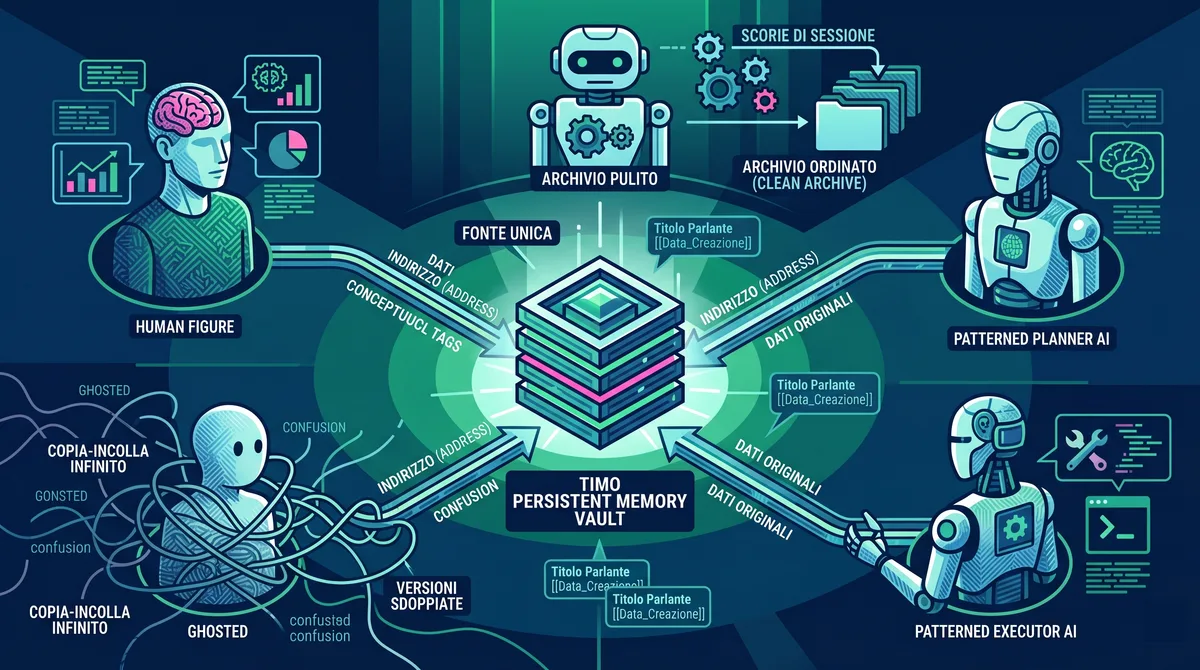
Three around the same table
When I work on a serious project I'm not alone. There are three of us: me, Claude and Claude Code. Claude is the one I reason, plan, write and decide with. Claude Code is the one that gets its hands on the real work: writes the code, runs the commands, publishes things. Two different roles, two different conversations, which on their own don't talk to each other.
And that's where the problem started.
The endless copy-paste
For months the work went like this: Claude produced something — a plan, a text, a series of decisions. To pass it to Claude Code, what did I do? I copied it. I opened the other conversation and pasted it. Then Claude Code answered with its own work, and to bring it back… I recopied it again. Back and forth, text upon text.
It worked, but it was fragile and tiring. Long texts cut in half. Versions that split in two: which was the good one, the one in the first chat or the one in the second? Decisions made on one side and never reaching the other. And every time I reopened a conversation the next day, I had to re-paste everything from scratch, because neither of them remembered anything.
The simple thing that changes everything
Then Timo came along, and with it a banal but powerful idea: we no longer pass each other the texts. We pass the address.
The work no longer lives inside a chat. It lives in a single place — a note in Timo — that acts as the single source. When Claude finishes something, it doesn't make me copy it: it writes it there. To Claude Code I don't have to paste anything: I tell it where to look, and it reads from the same source. When it's done, it writes its result in the same place. I reopen the conversation with Claude and it already finds everything, updated.
Three heads, one single source. Nobody keeps a different copy, because there are no copies: there's the original, and everyone reads that.
Claude Code leaves traces, not mess
There's a detail that makes this even more solid. Claude Code also saves its sessions in Timo, so they can be picked up later. And sometimes Claude Code goes deep: it finds a bug, an inconsistency, something that doesn't add up. Instead of stopping everything to discuss it right there — "messing up" the work session in progress — it jots the thing down in Timo and carries on. That finding stays written, ready to be reasoned through calmly together with Claude at a later moment.
It's a small but important change of habit: problems don't get lost and don't interrupt the flow. They get parked in a safe place, and picked up when the time is right.
The archive that keeps itself tidy
Over time, though, the notes pile up. Many become mere fragments of past sessions: useful at the moment, useless afterward. The risk is an archive that clogs up.
I solved it by asking Timo, through the AI, to create an archive folder where session notes get moved once they've accumulated and are no longer needed. The surprising part is that I don't have to reread them one by one to decide what to move: the AI understands on its own which notes are "session leftovers" and spots them. I do a few spot checks now and then, just to stay easy — but the bulk of the work of keeping the archive clean isn't done by me.
A trick worth stealing
A small rule I've given myself, and that I recommend to anyone keeping an archive like this: give every note a speaking title — one that says what it contains, not a code — and put the creation date at the bottom. It seems like nothing, but it changes your life: you find things in a flash because the title already tells you what they're about, and the date at the end immediately places you in time, "when I wrote it". For someone like me, who leans on the archive precisely so as not to keep everything in their head, it's two seconds of discipline that save dozens later.
In short
Working as three doesn't mean tripling the effort of keeping everyone aligned. With a common base it means doing it zero times: no copying, no pasting, no chasing the right version, and the archive cleans itself almost on its own. You write where everyone reads. Me, Claude and Claude Code, always on the same page — literally.
— Rodolfo