
AIs have a well-known tendency: to complete things even when they don't have enough information. They invent a file, a path, a decision made in a conversation that never happened. It's called hallucination, and when you're working for real it costs real mistakes — code that breaks, files lost, wrong choices made on your behalf.
One day I was planning something complex with Claude. I gave it an ambiguous reference: "add this to the to-do list at position 3.6 — 3.5 was scheduled for today, if I'm not mistaken".
The problem is that "3.6" didn't match anything clear in the ongoing conversation. It could have been at least four different things: a numbering from a list we'd looked at earlier, one from another document, a mental outline of mine I'd never written down anywhere, or a reference to a chat from the previous days.
Claude didn't guess.
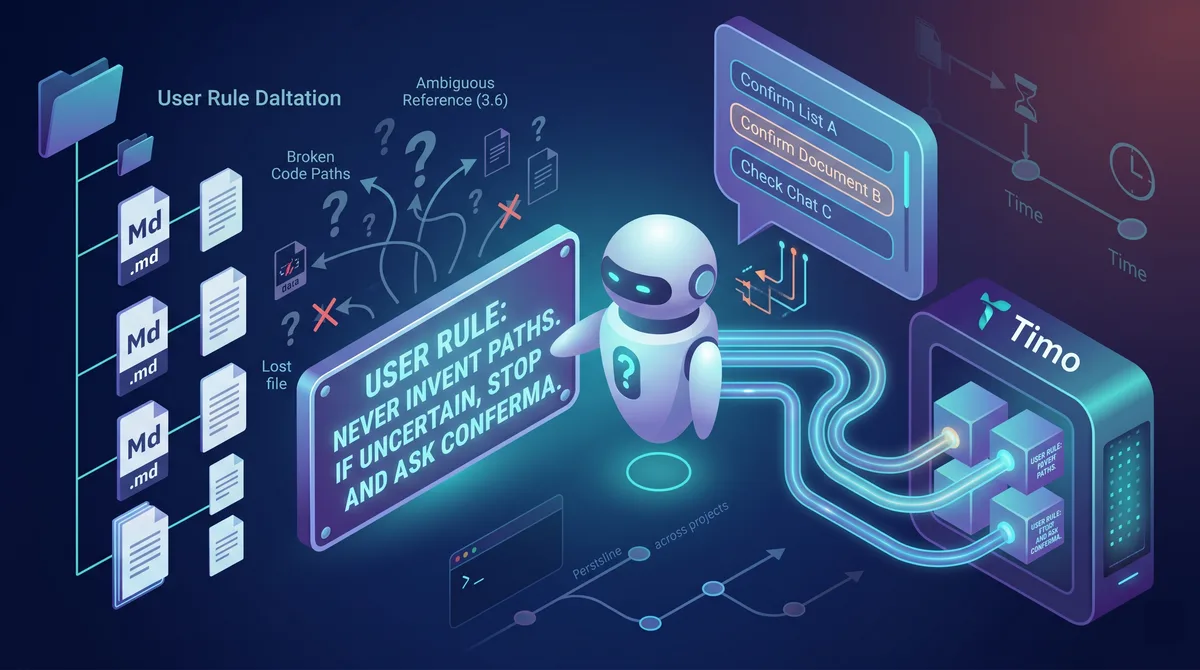
It didn't drop the content into a random spot. It didn't silently rewrite the list hoping to get it right. It didn't touch any file to "interpret" what I meant. Instead it searched my Timo archive for the numberings that could match, found a few plausible ones, and asked me to confirm three specific points before laying a hand on anything important.
Reliable AIs aren't the ones that always talk. They're the ones that know when not to talk.
And here's the part that's about Timo. This behavior wasn't a lucky accident. It's the result of a rule I wrote myself, once, in my archive: never invent file names or paths; if you don't know an exact name, ask before proceeding. That rule lives over time. Every new Claude session reads it before answering, and behaves accordingly.
It's a different kind of memory from the one people usually think of. It's not memory of data — it's memory of behavior. You write down once how you want your AI to behave, and all future sessions obey. The relationship changes: from "I hope it guesses right" to "we work together on the facts".
— Rodolfo